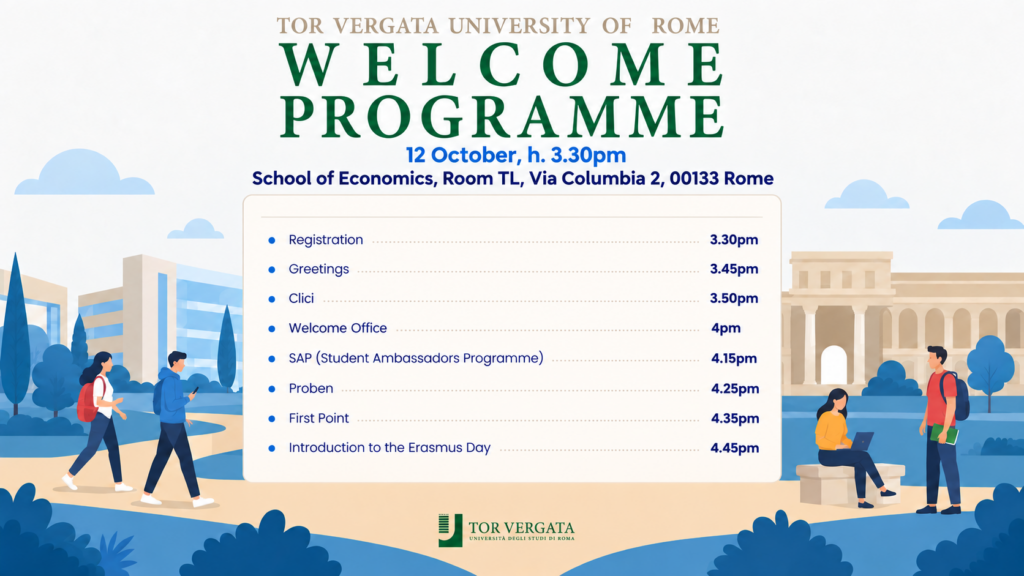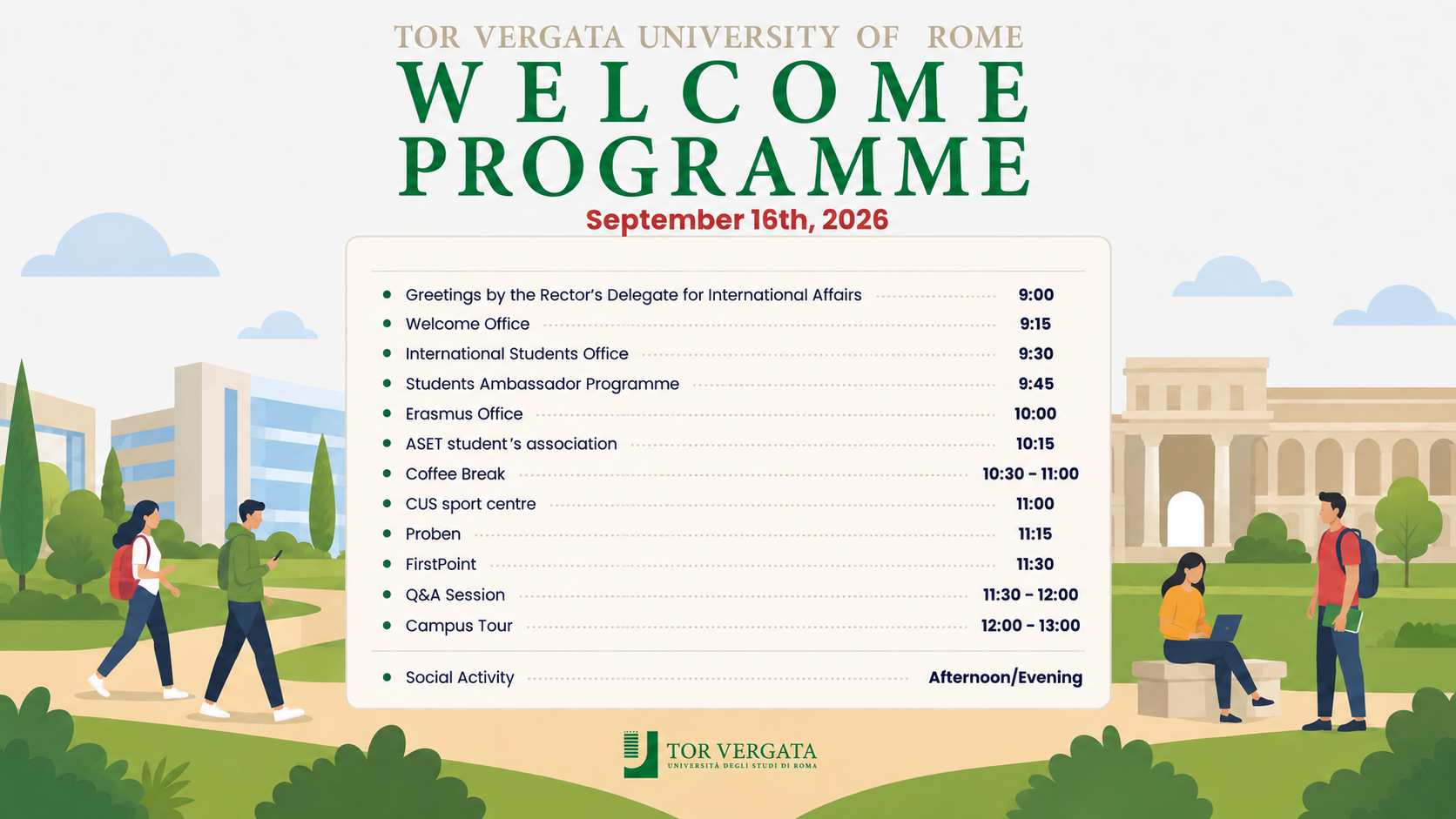
Students Welcome – 12 October 2026 h. 15:30 School of Economics, Room TL

Students Welcome – 12 October 2026 h. 15:30 School of Economics, Room TL

📢 Welcome Event for Freshmen / Enrolled Students – Second Session

As previously announced, a second welcome event for newly enrolled students will take place this month!

🗓 Date: October 12

⏰ Time: Starting at 15:30 (3:30 PM)

📍 Location: School of Economics, Room TL

This session will immediately precede the Erasmus Day event, which will be held in the same location starting at 17:00 (5:00 PM).

ℹ️ Note: A third event is scheduled for November (exact date TBD) to welcome late-arriving Non-EU students with the same format.
Election of Student Representatives

Election of Student Representatives

🎓 STUDENT ELECTIONS | MECHATRONICS ENGINEERING DEGREE COUNCIL 🎓
====================================================================
Represent Your Peers – Make Your Voice Heard!
——————————————————————–
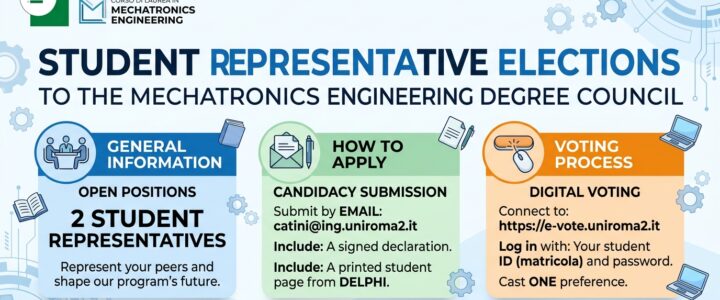
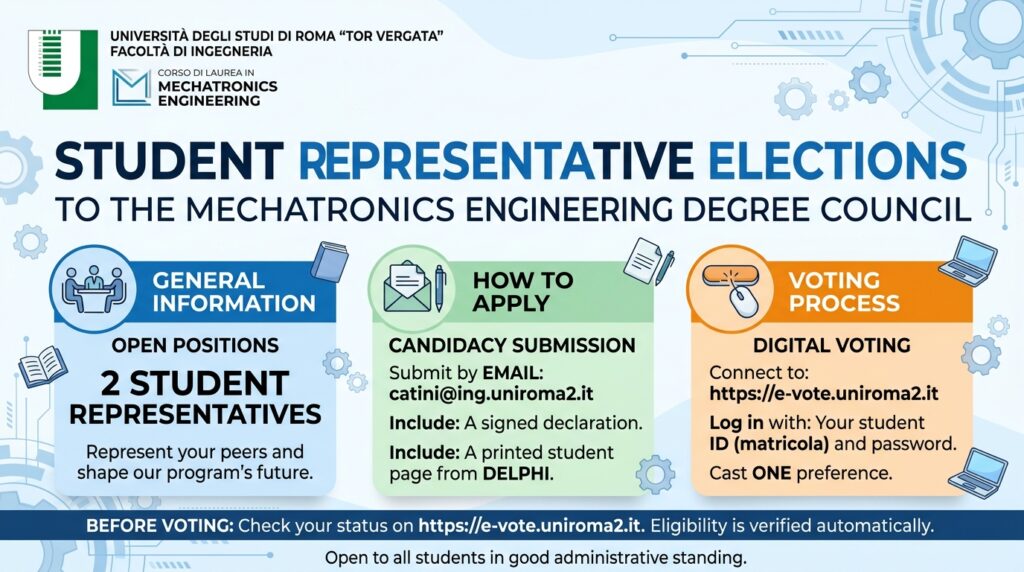
🗳️ Positions: 2 Student Representatives
🗓️ First Round: October 20, 2026 (00:00 – 23:59)
🗓️ Second Round: October 23, 2026 (00:00 – 23:59) [if quorum is missed]
📍 Platform: https://e-vote.uniroma2.it

⏰ CANDIDACY DEADLINE: October 5, 2026, by 12:00 PM

1. Key Dates & Deadlines

  • Candidacy Submission Deadline: October 5, 2026, at 12:00 PM.

  • First Voting Round: October 20, 2026 (00:00 to 23:59).

  • Second Voting Round (if needed): October 23, 2026 (00:00 to 23:59).

2. Eligibility Criteria

  • Voters (Active Electoral Right): All students enrolled in the Mechatronics Engineering Degree program who are in good administrative standing (tuition fees paid) at the time of voting.

  • Candidates (Passive Electoral Right): Students enrolled in the program who are up to date with tuition fees at the time of candidacy application and have not exceeded the first year beyond the standard duration of the degree (primo anno fuori corso).

3. How to Submit Candidacy

  • Send an email to catini@ing.uniroma2.it by 12:00 PM on October 5, 2026.

  • Include a signed candidacy declaration.

  • Attach a printed copy/screenshot of your personal student page from the Delphi portal.

4. How to Vote & Verify Eligibility

  • Check Status: Visit https://e-vote.uniroma2.it before voting opens and click “Verifica iscrizione Liste Elettorali” to check your status.

  • Voting Process: Visit the same link, click “Vota”, log in using your student ID (matricola) and password, and follow the step-by-step wizard.

  • Voting Limit: Each voter can select only one candidate.

2026_Indizione-elezione-studenti-CCS_Mechatronics.pdf

Mandatory Attendance – A.Y. 2026-27

Mandatory Attendance – A.Y. 2026-27

⚠️ IMPORTANT NOTICE

Please note that attendance is mandatory for all courses of the Master’s Degree in Mechatronics Engineering.

  • Minimum attendance required: 70% of lectures for each course

  • Attendance is monitored through a register

  • The requirement is mandatory to be admitted to the exam

  • For part-time students, the minimum percentage is proportionally reduced based on the agreed study duration

Students are invited to carefully review the course prerequisites in the course description section of the programme website.

More info:

Attendance is monitored through a register, and students must attend at least 70% of the lectures for each course to be admitted to the corresponding exam.

For part-time students (as regulated by Art. 13 of the Study Programme Regulations), the minimum attendance percentage is reduced proportionally. The required percentage is calculated by multiplying 70% by the ratio of the programme’s standard duration (2 years) to the agreed duration of the individual part-time study plan.
For example, if the agreed duration is 4 years, the coefficient is 2/4 = 0.5, and the minimum attendance requirement becomes 35%.

Dear First-Year Mechatronics Engineering Students,

You are strongly invited to participate in the meeting, which is expected to take place during the first weeks of October 2026. The meeting will provide you with your attendance-recording cards.

The exact date, time and venue will be announced on this page as soon as they are confirmed.

Please check this page regularly for updates.

Students who are unable to attend the meeting must inform the Didactic Secretariat promptly.

Kind regards,

CLICI – Courses in Italian language Academic Year 2026–2027

Clici

The CLICI – Center for Italian Language and Culture of the University of Rome Tor Vergata offers  Italian Language and Culture Courses for foreign students enrolled at the university as well as for external participants. 

Please note: Participation in CLICI Italian Language and Culture Courses is highly encouraged; however, these courses are extracurricular and do not count towards the degree requirements or elective credits of the M.Sc. in Mechatronics Engineering.

http://clici.uniroma2.it/en/courses/courses-in-italian-language-for-tor-vergata-foreign-students/

The singer “Ultimo” at Tor Vergata

The singer “Ultimo” at Tor Vergata

A Landmark Event for Italian Music and the University of Rome Tor Vergata

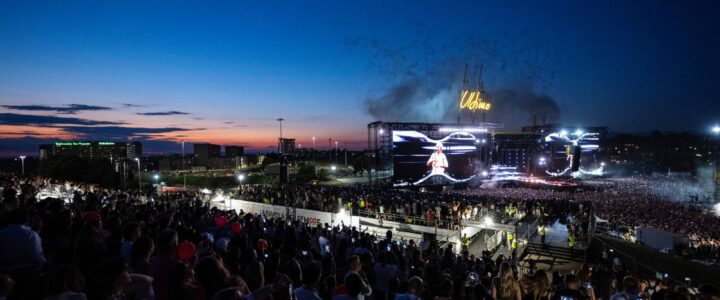
On Saturday, 4 July 2026, the University of Rome Tor Vergata hosted a landmark event for both Italian music and the university itself. “La favola per sempre”, the concert by Ultimo, brought together 250,000 spectators across a dedicated 15-hectare area within the University’s campus.

The project involved the University for more than a year and required the commitment of a large number of people. A “dream”, as Niccolò Moriconi repeatedly described it from the stage, was made possible through close collaboration with the artist and his management team, as well as the production company Vivo Concerti.

One aspect made this event particularly unique: the proactive involvement of students from the University of Rome Tor Vergata.

This was highlighted by Rector Nathan Levialdi Ghiron during the press conference held on the day of the concert:

“On this occasion, the University of Rome Tor Vergata once again demonstrates its outstanding capacity for hosting major events and its openness to Third Mission initiatives that engage not only the academic community but society as a whole, especially young people. This event reflects remarkable organizational capabilities, made possible through close cooperation with all the institutions involved, the event organizers, the Municipality of Rome, the Prefecture, the Rome Police Headquarters, and all the public services that contributed to its success.

It is also an opportunity for the University to open itself to society by enabling our students to play an active role. During the event, two highly significant research projects are being carried out: one focusing on the analysis of sound propagation, and another on measuring the performance of telecommunications networks in a setting where the concentration of people approaches or exceeds 250,000 attendees.

It is also a valuable opportunity to test new organizational models for large-scale events. I believe this collaboration can continue in the future, offering excellent opportunities to build on this experience and apply it to other major events. I would therefore like to thank all the institutions and everyone who contributed to making this important initiative possible.”

Courtesy of the University Press Office.

Source: the University’s official website.

https://web.uniroma2.it/it/contenuto/ultimo-a-roma-tor-vergata-il-giorno-che-aspettavamo-stato-qui


Seminar “Fundamentals of Skin” – 23 June 2026

Seminar “Fundamentals of Skin” – 23 June 2026

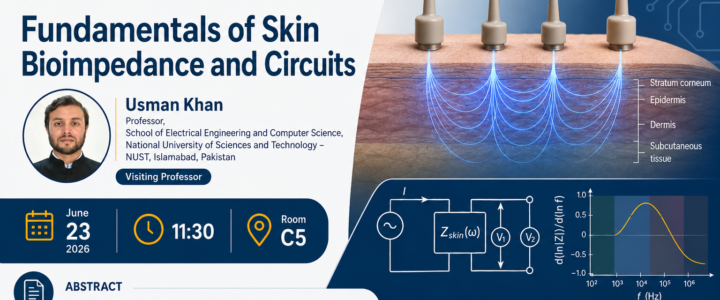
June 23, 2026, room C5, 11:30, the Seminar “Fundamentals of Skin” will take place

Bioimpedance and Circuits”, Usman Khan (School of Electrical Engineering and Computer Science,

National University of Sciences and Technology – NUST, Islamabad, Pakistan), Visiting Professor per il Dipartimento di Ingegneria Elettronica (file allegato).

Abstract: The seminar will introduce the fundamentals of skin bioimpedance and its application to skin characterization and disease diagnosis. The challenges associated with skin impedance measurements and the motivation for using four-electrode measurement techniques will be discussed. As to the underlying biophysics, the concept of current tubes and the normalized derivative approach for selective characterization of specific skin layers will be presented. Lastly, ongoing research activities and future research directions will be discussed.