Digital Signal Processing – 9 CFU (optC1.b/optC2.b)

Digital Signal Processing – 9 CFU (optC1.b/optC2.b)
1 YEAR II semester  9 CFU
ICT and Internet Engineering
Marina RUGGIERI (cfu)

Tommaso ROSSI (cfu)

A.Y. 2025-26 

Syllabus📑

Code: 80300072
SSD: ING-INF/03

The Digital Signal Processing teaching modules offer students the opportunity to become designers, providing a solid theoretical basis, multiple design techniques and Matlab script development skills.

DSP is offered to Mechatronics students with the option of 6 credits and 9 credits format. Students who select the 6-credit option might be interested in adding 3 credits of formative activities, with a focus on pre-assigned additional topics in the DSP realm.


Digital Modeling of Energy Conversion – 6 CFU (block A-B) (since 2025-26)

Digital Modeling of Energy Conversion – 6 CFU (block A-B) (since 2025-26)
1 YEAR
1 semester 6 CFU
Vincenzo MULONE (3cfu)

Pietro MELE (3cfu)

A.Y. 2025-26
didatticaweb
Syllabus📑

Code:
SSD: ING-IND-08
(by Mechatronics Engineering)

Digital Modeling of Energy Conversion 9 – Block A-B

Mechanics of Systems for Simulations – 6 CFU (block A-B) (since 2025-26)

Mechanics of Systems for Simulations – 6 CFU (block A-B) (since 2025-26)
1 YEAR
1 semester 6 CFU
(ex FUNDAMENTALS OF MECHANICS OF SYSTEMS)
Marco Ceccarelli A.Y. 2025-26 program 📑
Code: 80300216 
SSD: ING-IND-13
(by Engineering Sciences)


PREREQUISITES: knowledge of basic mechanics of rigid bodies and computation skills

SYLLABUS

Structure and classification of planar mechanical systems, kinematic modelling, mobility analysis, graphical approaches of kinematics analysis, kinematic analysis with computer-oriented algorithms, dynamics and statics modelling, graphical approaches of dynamics analysis, dynamic analysis with computer-oriented algorithms, performance evaluation, elements of mechanical transmissions.

BOOKS:

Lopez-Cajùn C., Ceccarelli M., Mecanismos, Trillas, Città del Messico
Shigley J.E., Pennock G.R., Uicker J.J., “Theory of Machines and Mechanisms”, McGraw-Hill, New York
Handnotes and papers by the teachers

INTEGRATED SOLUTIONS FOR SUSTAINABLE MOBILITY AND ENERGY PRODUCTION – 6 CFU (C2)

CEM
1 YEAR II semester 6 CFU
(from Mechanical)
Lorenzo BARTOLUCCI (3cfu)
Matteo BALDELLI (3cfu)
A.Y. 2024-25
Code: 80300136
SSD: ING-IND/08
  • Prerequisites: No prior kknowledge is required, although notions about energy systems and an understanding of error and data analysis can facilitate the student. All the knowledge necessary to pass he exam will be provided during the course.
  • OBJECTIVES: The goal of the course is to provide students with both a detailed and holistic view of the energy landscape for sustainable mobility and its impact on the overall energy system. The course aims to bridge the production of key energy carriers (electricity, hydrogen, biofuels, etc.) with their use in mobility, addressing issues of integration and optimization. To this end, students will expand their understanding of the fundamental physics behind these technologies, combining theoretical/modeling aspects with experimental approaches through laboratory activities. Lastly, particular attention will be given to the presentation and critical analysis of data obtained both experimentally and through numerical modeling.


Electric Propulsion – 6 CFU (optC2.b)

Electric Propulsion – 6 CFU (optC2.b)
1 YEAR (Block C2)
II semester 6 CFU
(from Mechanics – Energetics)
Prof. Marcello PUCCI
since A.Y. 2024-25

Syllabus📑

didatticaweb

Code: 80300151
SSD: ING-IND/32

Prerequisities

It is suggested to have the basic knowledge of Electrical Network Analysis and Power Electronics

SYLLABUS

The course will be articulated in the following way:
– Electric Vehicles
– Hybrid Electric Vehicles
– Electric Propulsion Systems for vehicles
– Series Hybrid Electric Drive Train Design
– Parallel Hybrid Electric Drive Train Design
– Energy Storage (Batteries, Supercapacitors – Ultrahigh-Speed Flywheels, Hybrid)
– Fuel Cell Vehicles
– Ship propulsion systems
– Vehicle to Grid (V2G) and Grid to Vehicle (G2V)

TEXTS

Educational material provided by the teacher

– John M. Miller, Propulsion Systems for Hybrid Vehicles, IET, 2008
– Iqbal Husain, Electric and Hybrid Vehicles: Design Fundamentals, 2010, CRC Press
– Mehrdad Ehsani, Yimin Gao, Ali Emadi, Modern Electric, Hybrid Electric, and Fuel Cell
Vehicles: Fundamentals, Theory, and Design, 2017, CRC Press

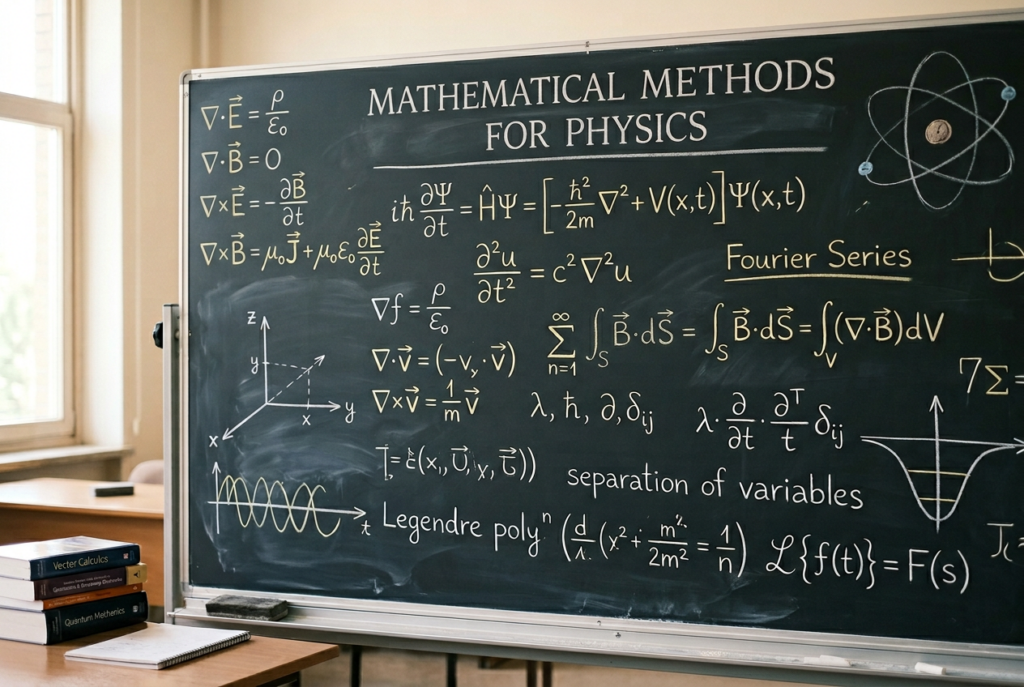
MATHEMATICAL METHODS FOR PHYSICS – 8 CFU (block D)

MATHEMATICAL METHODS FOR PHYSICS – 8 CFU (block D)
1 YEAR (Block D)
1 semester 8 CFU
(from Physics)
Prof. Giuseppe DIBITETTOGiuseppe.Dibitetto@roma2.infn.it A.Y. 2024-25 – program 📑
Code: 80300141
SSD: FIS/02
https://www.master-mass.eu/s1-mathematical-methods-for-physics/https://www.fisica.uniroma2.it/insegnamenti/mathematical-methods-for-physics/


On Board Energy Generation and Storage – 6 CFU (optC2.a)

On Board Energy Generation and Storage – 6 CFU (optC2.a)
1 YEAR (Block C2)
1 semester 6 CFU
Prof. Fabio Matteocci
A.Y. 2024-25 (new) program 📑
Code: 80300150
SSD: ING-INF/01


The course requires a basic knowledge of nanotechnologies applied to the generation and storage of electric power, as well as a basic understanding of the functioning of solar cells and batteries.

FORMATIVE OBJECTIVES

LEARNING OUTCOMES:

The main objectives of the course are the study of electric power generation and storage systems that can be implemented on vehicles. The lessons, therefore, focus on next-generation photovoltaics, thin-film deposition techniques, storage systems, supercapacitors, and thermoelectricity. The generation and storage technologies will then be studied from an application perspective through case studies.

KNOWLEDGE AND UNDERSTANDING:

Students will be able to:

a) To learn the working principles for energy generation and storage (EGS);
b) To understand and explain the solutions for EGS when applied in vehicles;
c) To solve simple problems concerning the use of design of integrated EGS systems;
d) To know how to design, develop and release a simple EGS system for vehicle integration.

APPLYING KNOWLEDGE AND UNDERSTANDING:

The student will be able to recognize the applicability areas for the various EGS systems. She/He will also be able to apply the knowledge and understanding developed during the course to study and understand recent literature.

MAKING JUDGEMENTS:

Students should be capable of identifying specific design scenarios and applying the most appropriate techniques for EGS. Additionally, they should be able to compare the effectiveness of various EGS systems while evaluating their advantages and disadvantages.

COMMUNICATION SKILLS:

The student will be able to clearly and unequivocally communicate the course content to specialized interlocutors. He will also be able to communicate the main approches to the development of EGS systems. The student will also have a sufficient background to undertake a thesis/research work in EGS applications.

LEARNING SKILLS:

Being sufficiently skilled in the specific field to undertake subsequent studies characterized by a high degree of autonomy.

SYLLABUS

1. Introduction on Nanotechnology: Top Down and Bottom Up Approaches2. Physical, Chemical Deposition, Solution Processing (Working Principle and Applications) 3. Energy Generation: Conventional and Emergent Photovoltaics (Working Principle and Applications).
4. Case of Study: Perovskite solar Cells (Working Principle, Deposition Techniques and applications)
5. Storage: Conventional and Emergent technologies for Batteries
6. Electrical and Chemical Properties of Batteries (Working Principle)
7. System Integration of Energy Generation and Storage solutions
8. Opportunities and Limitations of vehicle-integrated solutions for Generation and Storage 9. Beyond Batteries: Supercapacitors and thermoelectricity

The lecture will be held in the classroom with the projection of slides that will be released to the students at the end of the lecture.

The student will only be admitted to the final exam if they have attended 80% of the course hours.


Electronic Interfaces – 6 CFU (block E, optB, optC1.b, optC2.b)

Electronic Interfaces – 6 CFU (block E, optB, optC1.b, optC2.b)
1 YEAR II semester  6 CFU
Christian Falconi A.Y. 2022-23 (since)
A.Y. 2023-24 (new block E) 
Christian Falconi (4)

Usman Khan (2)

A.Y. 2025-26
didatticaweb

Syllabus📑

Code: 80300103
SSD: ING-INF/01