VLSI CIRCUIT AND SYSTEM DESIGN – 9 CFU (ALL)

VLSI

VLSI

ALL BLOCKS
1st Year II semester

Course Information
Course Code 8039166
Credits  9 CFU (7 + 2)
Offered by Mechatronics Engineering
SSD2015 ING-INF/01
SSD2024 IINF-01/A
note

Lecturer
Current Lecturer
Dr. Alessia DI VITO
☏ 06. 7259. 7777
Dr. Gemma GILIBERTI
since a.y. 2025-26
Previous Lecturers

Prof. Luca DI NUNZIO (5 cfu) a.y. 2022-23 to 2024-25 (9 cfu) a.y. 2021-22

Dr. Vittorio MELINI (2 cfu) a.y. 2022-23 to 2024-25

Dr. Sergio SPANO’ (2 cfu) a.y. 2022-23 to 2024-25

Grading Criteria
Evaluation Written examination
Oral examination
Problem assessment

Resources
Links

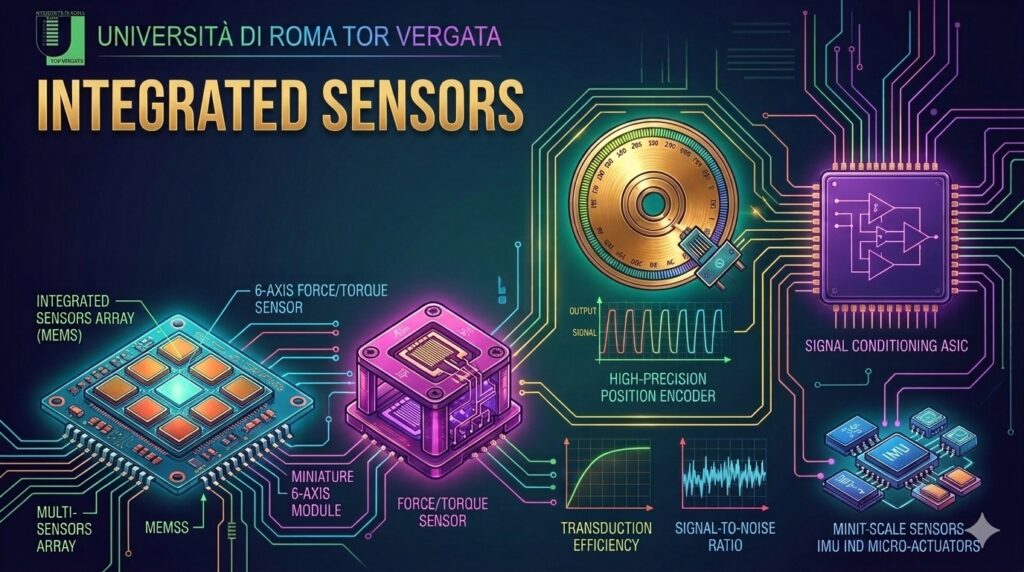
INTEGRATED SENSORS – 9 CFU (ALL)

INTEGRATED SENSORS – 9 CFU (ALL)

ALL BLOCKS
1st Year I semester
Course Information
Course Code 8039927
Credits  9 CFU (8+1)
Offered by Mechatronics Engineering
SSD2015 ING-INF/01
SSD2024 IINF-01/A
note A.Y. 2019–20: new course name – Integrated Sensors (formerly Electronic Devices and Sensors)
Lecturer
Current Lecturer
Prof. Alexandro Catini
✉ catini@ing.uniroma2.it
☏ 06. 7259.7349
Prof. Corrado Di Natale
Previous Lecturer
Alexandro Catini (6 cfu) 2022-23
Corrado  Di Natale (3 cfu) 2022-23
Corrado Di Natale (9 cfu) 2019-20


Grading Criteria
Evaluation written examination


Resources
Links

NANOTECHNOLOGY 6 CFU (ALL)

NANOTECHNOLOGY 6 CFU (ALL)

ALL BLOCKS
1st Year I semester

Course Information
Course Code 8039791
Credits  6 CFU (5+1)
Offered by Mechatronics Engineering
SSD2015 ING-INF/01
SSD2024 IINF-01/A
note

Lecturer
Current Lecturer
Prof. Antonio Agresti
✉ antonio.agresti@uniroma2.it
☏ 06. 7259.7562
Dr Sara Pescetelli
since a.y. 2024-25
Previous Lecturer
Prof. Francesca De Rossi (3 CFU) 2021-22
Fabio Matteocci (3 CFU) 2022-23 to  2023-24

Grading Criteria
Evaluation Oral examination

Resources
Links

Digital Signal Processing – 9 CFU (optC1.b/optC2.b)

Digital Signal Processing – 9 CFU (optC1.b/optC2.b)
1 YEAR II semester  9 CFU
ICT and Internet Engineering
Marina RUGGIERI (cfu)

Tommaso ROSSI (cfu)

A.Y. 2025-26 

✅ Syllabus📑

Code: 80300072
SSD: ING-INF/03

The Digital Signal Processing teaching modules offer students the opportunity to become designers, providing a solid theoretical basis, multiple design techniques and Matlab script development skills.

DSP is offered to Mechatronics students with the option of 6 credits and 9 credits format. Students who select the 6-credit option might be interested in adding 3 credits of formative activities, with a focus on pre-assigned additional topics in the DSP realm.


COMPUTER VISION – 6 CFU (since 2024-25)

COMPUTER VISION – 6 CFU (since 2024-25)
2 YEAR II semester  6 CFU
Arianna Mencattini A.Y. 2023-24 (ex MEASUREMENT SYSTEMS FOR MECHATRONICS)

A.Y. 2024-25: Computer Vision

didatticaweb
✅ Syllabus📑

Code: 8039787
SSD: ING/INF/07

Electronic Interfaces – 6 CFU (block E, optB, optC1.b/optC2.b)

Electronic Interfaces – 6 CFU (block E, optB, optC1.b/optC2.b)
1 YEAR II semester  6 CFU
Christian Falconi A.Y. 2022-23 (since)
A.Y. 2023-24 (new block E) 
Christian Falconi (4)

Usman Khan (2)

A.Y. 2025-26
didatticaweb

✅ Syllabus📑

Code: 80300103
SSD: ING-INF/01

Adaptive Systems (block C-opt) –> Identification and Neural Networks (24-25)

Adaptive Systems (block C-opt) –> Identification and Neural Networks (24-25)
2 YEAR II semester  6 CFU
Patrizio Tomei (4cfu)
Eugenio Martinelli (2cfu)
A.Y. 2023-24
SANTOSUOSSO Giovanni Luca A.Y. 2024-25 not be activated
A.Y. 2025-26
(new name “Identification and Neural Networks”
Didatticaweb
Code: 80300088
SSD: ING-INF/04

Pre-requirement: The basics of systems theory and control are required.

LEARNING OUTCOMES: The course aims to provide the basic techniques for the design of predictors, filters, and adaptive controllers.

KNOWLEDGE AND UNDERSTANDING: Students must obtain a detailed understanding of design techniques with the help of MATLAB-SIMULINK to solve industrial problems of adaptive filtering, adaptive prediction, and adaptive control.

APPLYING KNOWLEDGE AND UNDERSTANDING: Students must be able to apply the project techniques learned in the course even in different industrial situations than those examined in the various phases of the course.

MAKING JUDGEMENTS: Students must be able to apply the appropriate design technique to the specific cases examined, choosing the most effective algorithms.

COMMUNICATION SKILLS: Students must be able to communicate using the terminology used for filtering, prediction, and adaptive control. They must also be able to provide logical and progressive exposures starting from the basics, from structural properties, from modeling to the design of algorithms, without requiring particular prerequisites. Students are believed to be able to understand the main results of a technical publication on the course topics. Guided individual projects (which include the use of Matlab-Simulink) require assiduous participation and exchange of ideas.

LEARNING SKILLS: Students must be able to identify the appropriate techniques and algorithms in real cases that arise in industrial applications. Furthermore, it is believed that students have the ability to modify the algorithms learned during the course in order to adapt them to particular situations under consideration.

Texts

Adaptive Filtering Prediction and Control, Graham C. Goodwin, Kwai Sang Sin, Dover Publications, 2009.

CONTROL OF ELECTRICAL MOTORS AND VEHICLES (B-C1-C2-E) (25-26)

CEM
2 YEAR II semester 6 CFU
Cristiano M. Verrelli A.Y. 2021-22 to A.Y. 2024-25 (Control of Electrical Machines (B-C-E))


A.Y. 2025-26 (new name CONTROL OF ELECTRICAL MOTORS AND VEHICLES )
didatticaweb
✅ All syllabi📑

Code:8039782
SSD: ING-INF/04


MEASUREMENT SYSTEMS FOR MECHATRONICS – 6 cfu (2023-24 last year)

MEASUREMENT SYSTEMS FOR MECHATRONICS – 6 cfu (2023-24 last year)
2 YEAR II semester  6 CFU
Arianna Mencattini A.Y. 2021-22

A.Y. 2022-23

A.Y. 2023-24 Measurement Systems for Mechatronics

A.Y. 2024-25: Computer Vision – program

Code: 8039787
SSD: ING/INF/07

LEARNING OUTCOMES: Learning basic concepts in digital image processing and analysis as a novel measurement system in biomedical fields. The main algorithms will be illustrated particularly devoted to the image medical fields.

KNOWLEDGE AND UNDERSTANDING: The student acquires knowledge related to the possibility to use an image analysis platform to monitor the dynamics of a given phenomenon and to extract quantitative information from digital images such as object localization and tracking in digital videos.

APPLYING KNOWLEDGE AND UNDERSTANDING: The student acquires the capability to implement the algorithms in Matlab through dedicated lessons during the course with the aim of being able to autonomously develop new codes for the solution of specific problems in different application fields.

MAKING JUDGEMENTS: :
The student must be able to integrate the basic knowledge provided with those deriving from the other courses such as probability, signal theory, and pattern recognition. some fundamentals of measurement systems as well as basic metrological definitions will be provided in support of background knowledge.

COMMUNICATION SKILLS:
The student solves a written test and develops a project in Matlab that illustrates during the oral exam. The project can be done in a group to demonstrate working group capabilities.

LEARNING SKILLS:
Students will be able to read and understand scientific papers and books in English and also to deepen some topics. In some cases, students will develop also experimental tests with time-lapse microscopy acquisition in the department laboratory.


SYLLABUS:

Fundamentals of metrology. Basic definitions: resolution, accuracy, precision, reproducibility, and their impact over an image based measurement system. Image processing introduction. Image representation. Spatial and pixel resolution. Image restoration. Deconvolution. Deblurring. Image quality assessment. Image enhancement. Image filtering for smoothing and sharpening. Image segmentation: pixel based (otsu method), edge based, region based (region growing), model based (active contour, Hough transform), semantic segmentation. Morphological operators. Object recognition and image classification. Case study: defects detection, object tracking in biology, computer assisted diagnosis, facial expression in human computer interface.
Matlab exercises.