ELECTRONICS OF IOT AND EMBEDDED SYSTEMS – 12 CFU

ELECTRONICS OF IOT AND EMBEDDED SYSTEMS – 12 CFU
2 YEAR 1 semester 12 CFU
Patrick LONGHI (3cfu)
Giancarlo ORENGO (3cfu)
Gian Carlo CARDARILLI (4cfu)
Luca DI NUNZIO (2cfu)
since A.Y. 2019-20
M-5519 – ELECTRONICS OF IOT (6cfu)
M-5520 – DESIGN OF EMBEDDED SYSTEMS FOR MECHATRONICS (6cfu)
Syllabus📑

Code: 8039795
SSD: ING-INF/01

EDUCATIONAL OBJECTIVES:
The objectives of the course are:
1) to provide the tools to carry out a radio link assessment in a real application context.
2) learn the fundamental parameters of the antennas used in IoT applications
3) provide the tools to interpret the electrical diagram of the RF front end of a typical trans receiver.

KNOWLEDGE AND UNDERSTANDING:
Provide the fundamental tools to understand the most advanced and updated content from publications, magazines, forums, blogs, etc., to always be updated on the state of the art.

ABILITY TO APPLY KNOWLEDGE AND UNDERSTANDING:
Practical radio link budget, electronic noise evaluation on receiver behavior, installation effects of the antennas, understanding of key parameters of commonly used antennas in the targeted scenario, analysis of an RF transceiver block diagram

AUTONOMY OF JUDGMENT:
With the enormous amount of information that is available today to developers of IoT applications, the course seeks to develop the ability of the student to select the highest quality and most validated content.

COMMUNICATION SKILLS:
The final test is based on an oral exam in which the student illustrates a part of the module

LEARNING ABILITY:
The course aims to develop in the student the ability to independently learn new and constantly updated content because the knowledge acquired today soon becomes obsolete.

SYLLABUS:

(Longhi):

Introduction to radiating elements and their key parameters.
Ideal and practical link budget.
The effect of noise in electronic receivers, figures of merit and mathematical modelling. Receiver G/T.
Practical aspects of IoT RF systems
RFID
Radiating elements key parameters, gain, directivity, HPBW, nulls, radiation pattern, polarization, and input impedance. Some practical cases: the mono/di-pole family, microstrip antennas, parabolic reflector, wearables
Introduction to RF transceiver systems and key-components (switches, HPA, LNA, mixers, frequency generators).

(G.Orengo):

Summary of Digital Electronics: digital encoding of information, binary (fixed and floating point), hexadecimal and ASCII; operators and main logic circuits, registers and memories, programmable devices. Prototyping boards for IoT (Arduino, Rasberry), Systems on Chip (SoC), architecture of a microcontroller, description of the Arduino Uno board. Programming languages ​​(assembly, compiled, interpreted), structure of an Arduino sketch (libraries, setups, loops, functions, interrupts), programming elements in C (variables, math and logical operations, cycles, conditional statements). Use of digital and analog I/O ports (A/D conversion, PWM output). Synchronous and asynchronous serial communication modes, wired (USB) and wireless with Bluetooth, RF and WiFi modules. Remote control of electronic modules (sensors, dc stepper and servo motors, LED/LCD displays etc.) from portable devices (Windows, IoS), through applications developed in Processing and Python, and mobile (Android), through Apps developed with the MIT App Inventor platform. Internet protocols for device local/remote control through WiFi modules connected as access points/clients to web platforms or public/private cloud servers controlled by laptops and/or mobile devices.

(G.Cardarilli):

– Introduction to the Internet of Things (IoT) and embedded systems
– Wireless and mobile communications
– The Sensors
– Low power processing
– IoT and machine learning applications
– Future developments in the field of IoT and embedded systems


POWERTRAIN TECHNOLOGIES FOR FUTURE MOBILITY – 9 CFU

POWERTRAIN TECHNOLOGIES FOR FUTURE MOBILITY – 9 CFU
2 YEAR  II semester  9 CFU
Stefano CORDINER (6/9 cfu)
Lorenzo BARTOLUCCI (3/9 cfu)
A.Y. 2021-22

Internal Combustion Engines

Since A.Y. 2022-23

POWERTRAIN TECHNOLOGIES FOR FUTURE MOBILITY

didatticaweb
✅ Syllabus📑

Code: 80300079

80300077 M-6264
SSD: ING/IND/08
(by Mechanical Engineering)

Digital Signal Processing – 6 CFU (optC1.b/optC2.b)

Digital Signal Processing – 6 CFU (optC1.b/optC2.b)
1 YEAR II semester  6 CFU
ICT and Internet Engineering
Marina RUGGIERI (5cfu)

Tommaso ROSSI (1cfu)

A.Y. 2025-26
Syllabus📑

 
Code: 8039514
SSD: ING-INF/03

The Digital Signal Processing teaching modules offer students the opportunity to become designers, providing a solid theoretical basis, multiple design techniques, and Matlab script development skills.

DSP is offered to Mechatronics students with the option of 6 credits and 9 credits format. Students who select the 6-credit option might be interested in adding a +3 credits of formative activities, with focus on pre-assigned additional topics of the DSP realm.

NANOTECHNOLOGY – 6 CFU

NANOTECHNOLOGY – 6 CFU
1 YEAR II semester  6 CFU
Antonio Agresti (3cfu)
Francesca De Rossi (3cfu)
A.Y. 2021-22
Antonio Agresti (3cfu)
Fabio Matteocci (3cfu)
A.Y. 2022-23
A.Y. 2023-24
Antonio Agresti (5cfu)

Sara Pescetelli (1cfu)

A.Y. 2024-25
A.Y. 2025-26

didatticaweb
 ✅ Syllabus📑

Code: 8039791
SSD: ING-INF/01


VLSI CIRCUIT AND SYSTEM DESIGN – 9 CFU

VLSI
1 YEAR II semester  9 CFU
Luca DI NUNZIO (9 cfu) A.Y. 2021-22
Luca DI NUNZIO (5 cfu)

Vittorio MELINI (2 cfu)

Sergio SPANO’ (2 cfu)

since A.Y. 2022-23
Alessia DI VITO (7cfu)

Gemma GILIBERTI (2cfu)

A.Y. 2025-26 

Syllabus📑

Code: 8039166
SSD: ING-INF/01


POWER ELECTRONICS AND ELECTRICAL DRIVES – 9 CFU

POWER ELECTRONICS AND ELECTRICAL DRIVES – 9 CFU
2 YEAR 2 semester 9 CFU
Stefano Bifaretti
A.Y. 2021-22
Stefano Bifaretti (7cfu)

Cristina Terlizzi (2cfu)

A.Y. 2022-23 1st Year I semester
A.Y. 2023-24  (NOT HELD)
A.Y. 2024-25
Stefano Bifaretti A.Y. 2025-26 – program 📑
Code: 8039781
SSD: ING-INF/01

LEARNING OUTCOMES:
The Power Electronics and Electrical Drives course aims to provide a basic understanding of the power semiconductors of the main electronic circuits used for the static conversion of electrical energy as well as the electrical drives. The student will acquire the ability to analyse and perform an initial sizing of power electronic converters operating in either direct or alternating current.

KNOWLEDGE AND UNDERSTANDING:
The student will be gradually guided to the knowledge of the functional characteristics and behavior of the main static power converters used, in particular, in industrial applications, in Distributed Generation Systems and in power trains of electical vehicles. In order to improve the topics understanding, the use of Matlab-Simulink specific packages for the simulation of electronic power converters is illustrated.

APPLYING KNOWLEDGE AND UNDERSTANDING:
The knowledge acquired during the course allows the student to select the topology and size of the power converter in relation to the final design.
Different application examples, in particular devoted to distributed energy generation plants, uninterruptible power supplies and electric mobility will allow the student to improve his ability to apply the acquired knowledge.

MAKING JUDGEMENTS:
The student will be able to collect and process specialized technical information on power converters and verify their validity.

COMMUNICATION SKILLS:
The student will be able to relate with power electronics specialists in order to request the technical information necessary for the development of a project activity.

LEARNING SKILLS:
The skills acquired during the course will allow the student to undertake, with a high degree of autonomy, subsequent studies or apply for technical roles in companies working in the field.


SYLLABUS:

POWER SEMICONDUCTORS

Power Semiconductors employed in Power Electronics converters: Diodes, BJT, MOSFET, IGBT, Thyristors, Wide Bandgap Semiconductors).

Static and dynamic behavior. Thermal behavior. Conduction and switching losses.

Technical specifications provided by manufacturers’ datasheets. Driving circuits.

POWER CONVERTER TOPOLOGIES

Behavioral characteristics: unidirectional and bidirectional energy transfer, controlled voltage sources. Analysis method of power converters.

DC-DC Converters. Buck, Boost, Buck-Boost. Switching losses reduction. Average Model. Modulation techniques (PWM, PFM, PRM). Output voltage open-loop control. Closed-loop control. Current control.Half and Full Bridge DC-DC converters.

DC-AC Converters (Inverters). Half and Full Bridge DC-AC single-phase converters based on static switches. Three-phase converters. Modulation techniques. Selective Harmonic Elimination (SHE). Sinusoidal Pulse Width Modulation (SPWM).

Rectifiers: Single-phase and three-phase diode rectifiers. Single-phase and three-phase force-commutated PWM rectifiers: topologies, voltage and current controls. Power Factor Corrector (PFC). Effects on grid side of power converters. Generalized power factor. Compliance with grid codes.
Isolated DC-DC converter.

ELECTRICAL DRIVES
Introduction to Electrical Drives. DC, Permanent Magnet Synchronous Motors and Induction Motors. DC motors model.

Power Electronics Applications

Power Converters simulation using Matlab-Simulink/Simpowersystem.
Photovoltaic Conversion Systems.
Power trains for electrical vehicles. Battery chargers.


ROBOT MECHANICS – 9 CFU

ROBOT MECHANICS – 9 CFU
1 YEAR (Blocks B|C)24-25
2 YEAR (Blocks A|D|E)24-25 (All)25-26
1 semester 9 CFU
Marco Ceccarelli (6/9 cfu)

Matteo Russo (3/6 cfu)

A.Y. 2021-22

A.Y. 2022-23

Matteo Russo (9cfu)
since A.Y. 2023-24 – program
Code: 8039785
SSD: ING-IND/13

LEARNING OUTCOMES: This course will provide students with the knowledge and tools needed to model and analyse robotic manipulators in terms of mechanical performance. Students will learn how to design, evaluate, and control industrial and service robots.

KNOWLEDGE AND UNDERSTANDING: The student will learn to analyse robotic systems by modelling their kinematics and dynamics and thus finding their key operational parameters. Furthermore, the student will learn how to design a manipulator from its operational requirements, such as workspace, velocity, and payload.

APPLYING KNOWLEDGE AND UNDERSTANDING: The student will apply this knowledge to design, model, and evaluate robots with examples of use cases. Once identified the joints and bodies that compose a robot, the student will be able to numerically characterize its operation and mobility. Furthermore, the student will be able to critically select a robot type for a given manipulation task.

MAKING JUDGEMENTS: The student will demonstrate their understanding of robot operation by developing and presenting a practical use case, in which they will examine autonomously and critically the challenges behind robot design and application.

COMMUNICATION SKILLS: During the course, students discuss key topics, working on a written project on manipulation analysis of their own choice. Project results are then presented at the end of the course.

LEARNING SKILLS: During the course, students are involved in the lecture for a continuous stimulus to verify their understanding of robot mechanics. The knowledge acquired during the course is also verified in the final project on manipulation analysis.

REQUIREMENTS: The student should have already attended the fundamental courses on calculus, geometry, and physics. The understanding of rigid body mechanics and basic programming skills (MATLAB) are required, as well as knowledge of mechanism design and analysis.

PROGRAMME:

  1. Architecture and classification of industrial and service robots
    1. Definitions: kinematic chains, joints, mobility
    2. Manipulation analysis
    3. Types of manipulators
  2. Kinematics
    1. Reference frames
    2. Denavit-Hartenberg notation
    3. Forward kinematics
    4. Inverse kinematics
    5. Jacobian and singularities
    6. Workspace
    7. Path planning
  3. Statics and dynamics
    1. Equilibrium
    2. Equation of motion
    3. Grasp mechanics
  4. Other designs
    1. Actuation technologies
    2. Parallel robots
    3. Compliant robots
    4. Soft and continuum robots

EXAM:

The exam is divided into a written and oral test. The written test consists of three exercises regarding practical use-cases of industrial and service robots. In alternative, a project report developed during the course can be evaluated. In the oral test, the student will discuss with a critical perspective robot functioning. In alternative, the developed project on manipulation analysis can be presented and discussed.

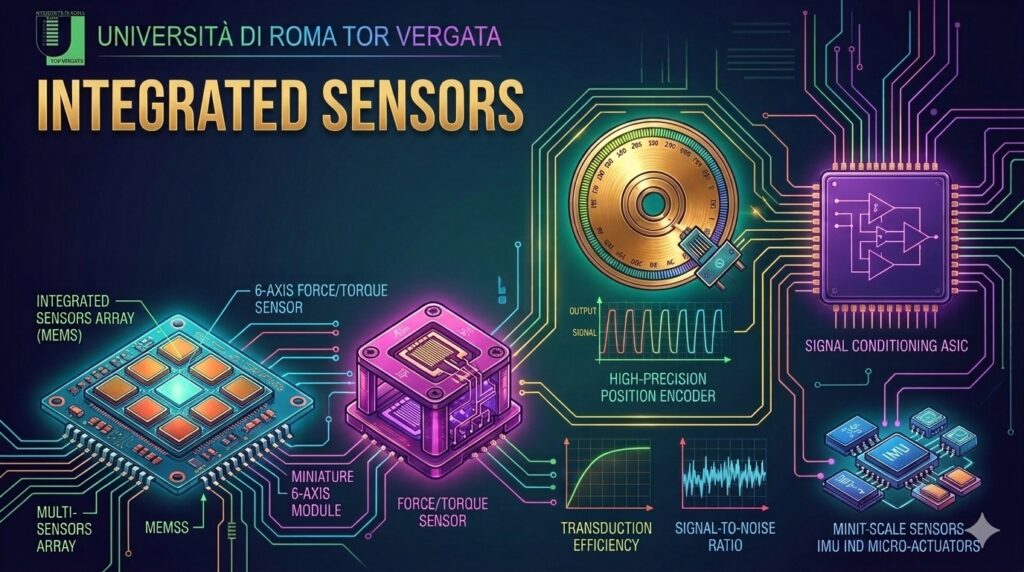
INTEGRATED SENSORS – 9 CFU

INTEGRATED SENSORS – 9 CFU
1 YEAR (ALL) 25-26
2 YEAR (Block B)24-25
1 semester 9 CFU
Corrado Di Natale A.Y. 2019-20 (new name, ex Electronic Devices and Sensors)
Alexandro Catini (6cfu)
Corrado  Di Natale (3cfu)
A.Y. 2022-23
A.Y. 2023-24
Alexandro Catini (8cfu) – catini@ing.uniroma2.it
Corrado  Di Natale (1cfu) 
A.Y. 2024-25
didatticaweb
Syllabus📑

Code: 8039927
SSD: ING-INF/01